

Agribusiness Atlas 2026
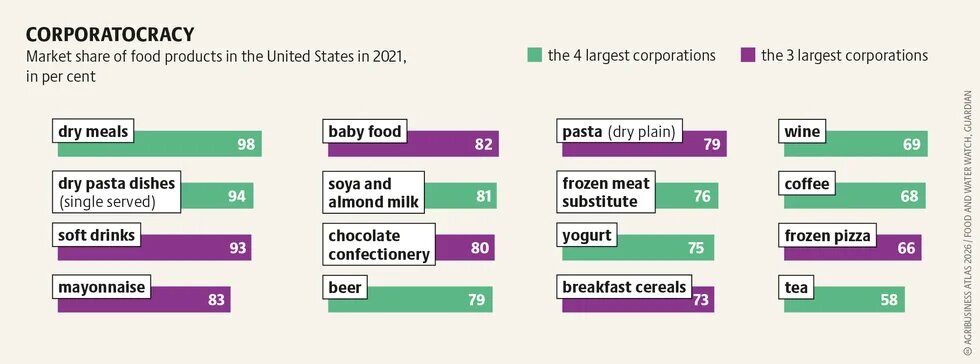
How are food prices determined? How are profits distributed along the supply chain? For consumers, this is often quite hard to discern. Scientific studies consistently show that prices are rarely determined by supply and demand alone. Instead, they are shaped by power relations within the food system.

Prices are rarely set cooperatively between farmers, processors, distributors, restaurants, retailers, and consumers. In many cases, the balance of power lies with food processors or major retailers. Because most products are standardised, they can be sourced from different regions or even from far-flung continents.
This strengthens the bargaining power of large buyers: standardisation places farmers in direct global competition with one another, despite widely differing production costs, and effectively imposes the lowest bidder's price. The drive among food processors and retailers to maximise profits is a key factor behind this dynamic. Wheat was the first crop to be standardised, in the 1850s, as a tradable commodity on the Chicago Board of Trade. Today, this principle extends to all crops, animal products, and even foods like bottled milk or sliced bread.
A recent French analysis identifies six typical mechanisms of price formation along food value chains, highlighting the complexity of how prices are set and profits distributed across the food system.
In the first price-formation model identified in the study, differentiated supply chains based on cooperation play a central role. In this model, prices are built from the bottom up, starting with agricultural production and moving through distributors, retailers and restaurants to consumers. It is closely associated with direct sales and short supply chains, as well as quality or origin labels such as organic farming, fair trade, or protected designations of origin like Champagne or Comté cheese. This model accounts for only 5 percent of the total value of the French food system.
The second model accounts for approximately 3 per cent of total turnover and is exposed than the first to the pressures of standardisation and price competition. It concerns products with quality or origin labels that are nevertheless sold at low prices as retailers' own-brand products. In this case, farmers are less likely to benefit.
The third pattern is the dominant one, centred on best-selling products from leading food and drink brands such as Nutella, Coca-Cola, KitKat, and Magnum ice cream. Although these brands represent only a very small share of supermarket product ranges, they account for 36 per cent Ð more than one third Ð of the total value generated by the French food system. Their success relies on their strong and clear appeal to consumers, maintained by very heavy investment in marketing and advertising. For farmers, there is little advantage, since these products rely not on the distinctive qualities of their ingredients but on a vast supply of standardised agricultural raw materials to sustain large-scale, uniform production. Most of the profits go to the big food processing corporations.
The fourth pattern corresponds to value chains characterised by strong price competition at all stages. It accounts for 11 per cent of the total value generated in the French food system. For consumers, these take the form of so-called loss leaders or ultra-low-priced food offers, such as bananas at 0.80 euros a kilogram or bottled milk at 0.75 euros a litre. In such cases, most actors struggle to cover costs. Large processors and retailers can compensate through their activities in other value chain models, but farmers engaged in standardised commodity production generally cannot.
Finally, the two remaining value chains account for 45 per cent of the total value generated by the French food system. They encompass a wide range of branded and own-label products. What they have in common is the ability of distributors, restaurants and other out-of-home food providers at the end of the chain to sell these products at higher margins, largely unnoticed by consumers. Yet, the food products involved are similar in composition to best-sellers, just less well-known and less in demand. In the middle of the chain, large brands are able to negotiate prices that secure substantial margins, though lower than those of best-sellers, while smaller brands and processors face intense competition. Once again, farmers do not receive higher returns.
The key problem is that the vast majority of these models accounting for 92 per cent of the French food system, with only the first two as exceptions fail to reward the distinctive qualities of agricultural raw materials or the work of farmers. Instead, they prioritise volume and economies of scale, creating value through marketing and advertising. This is driven by the pursuit of profitability among food and beverage brands, retailers, and restaurant chains seeking to remain competitive under capitalist market conditions, while agricultural prices and internal costs at each stage of the supply chain remain under constant pressure. Consumers lose out, too: studies show that major supermarket chains rarely pass on cost savings in the form of lower prices and instead often retain the gains themselves.
A handful of corporations dominate our food system, setting prices, profiting from crises, and driving relentless pressure on the environment, farmers, and consumers alike. The Agribusiness Atlas 2026 traces how this concentration of power took hold, and charts the political pathways toward a fairer food system built around the common good.
